

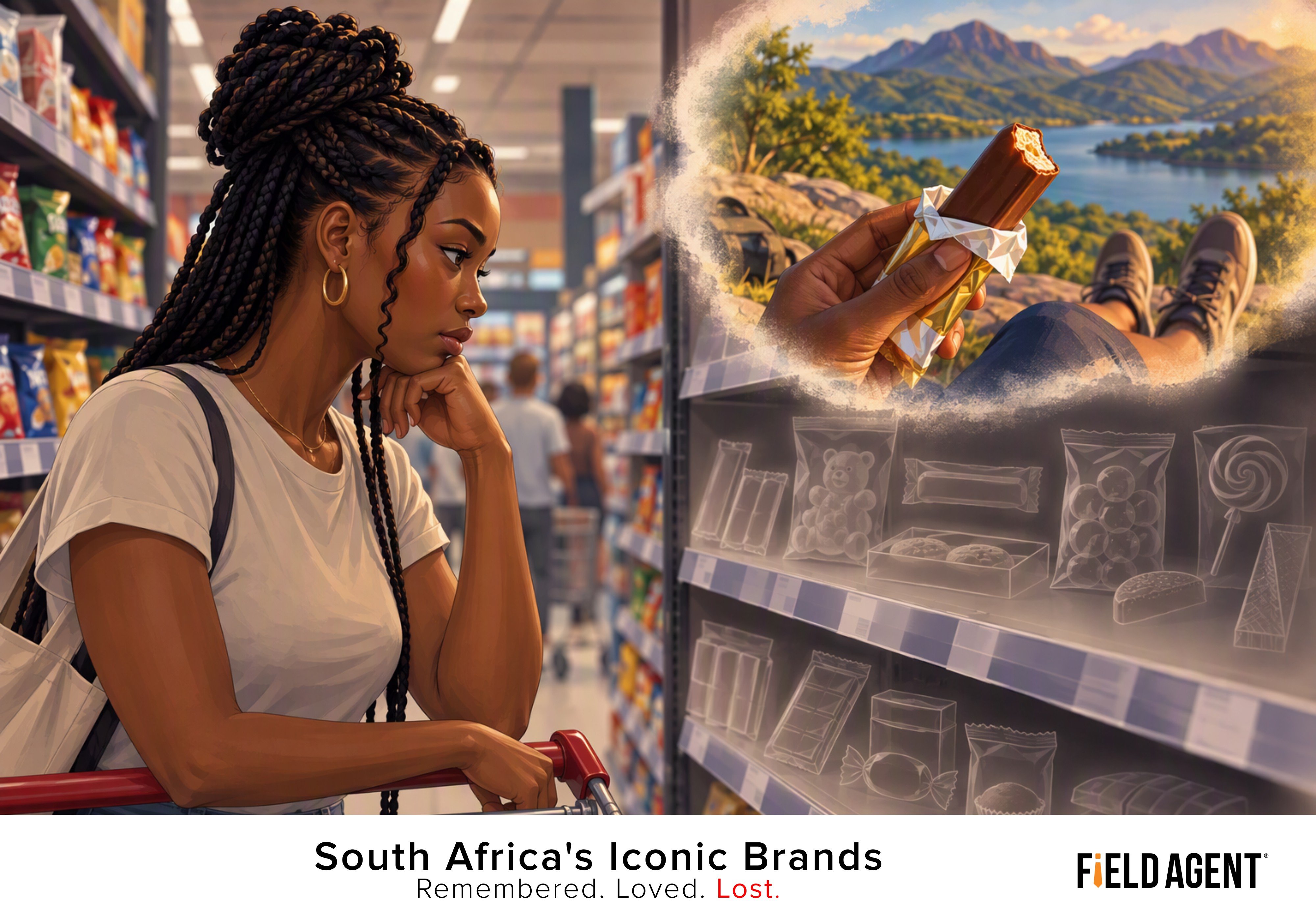
What 100 South Africans told us about the brands that shaped their childhoods and stayed with them.
Some brands live in a cupboard. Others live in our memories.
Mention Ouma Rusks, Sunlight, KOO, Simba, Oros, Jungle Oats, Vaseline, All Gold or Mrs Ball's to a group of South Africans, and you are unlikely to get a purely functional response. You are just as likely to hear about a kitchen, a parent or grandparent, school mornings, road trips, a tuck-shop or something that used to taste just right.
That was the idea behind Field Agent South Africa's consumer survey, South Africa's Iconic Brands: Remembered. Loved. Lost. We asked 100 South Africans about the brands they remembered growing up with, the brands they remain loyal to, the favourites they believe have changed and the products they would bring back if they could.
The Brands That Raised Us
Childhood brand recognition often begins long before people make their own purchasing decisions. Familiar products become part of family life, turning ordinary household routines into powerful brand-building moments.
Three categories dominated childhood brand memories:
- 74% selected sweets, chocolates and snacks
- 66% selected food
- 54% selected soft drinks and beverages
Respondents could select up to three categories. But the more revealing finding was why these brands were remembered: 79% said they were always present at home, 56% connected them with parents or family use, and 42% simply loved the product. Advertising mattered too, selected by 27%, but everyday presence was the stronger thread.
The breakfast table, grocery cupboard, bathroom shelf and family routine can be remarkably effective places for a brand to earn lasting recognition.
Consider this: How can your brand earn a place in everyday family routines and carry that connection into the next generation?
From Childhood Memories to the Modern Shopping Basket
A familiar name may bring back memories, but nostalgia alone does not guarantee a place in today's shopping basket. When respondents explained their current brand loyalty, practical performance led the way.
- 79% selected quality as a reason for staying loyal
- 46% selected taste or performance
- 38% selected value for money
Family use still mattered to 32%, while reliability was selected by 24% and habit by 21%. By comparison, only 4% selected nostalgia as a reason for current loyalty.
Names such as Sunlight, OMO, Vaseline, Jungle Oats and KOO appeared repeatedly in open-ended loyalty responses. They are examples rather than a ranked list, but they illustrate an important distinction: heritage can get a brand remembered; continued quality, performance, value and availability help keep it in the basket.
Consider this: Are your brand’s heritage and awareness still translating into repeat purchases? Keep sight of the quality, performance, value and availability that consumers rely on today.
When Familiar Favourites Lose Their Magic
Iconic status does not make a brand untouchable. Familiarity creates expectations around taste, quality, size and value, and consumers notice when the experience no longer matches the one they remember.
- 44% said there were brands they loved growing up that they no longer buy, even though those brands remain available
- 53% had noticed a favourite brand or product change so much that they liked it less
Taste or formula was the most frequently selected change at 37%, followed by quality at 32% and price or value at 24%. Size and packaging were each selected by 9%, while brand image and design were also mentioned.
These are consumer perceptions, not independent proof that a product has objectively declined. Yet perceptions still affect behaviour. If shoppers believe something tastes different, feels smaller, costs more or no longer delivers the expected experience, years of familiarity may not be enough to retain them.
Innovation can move a product forward, but it is worth testing which features customers value most before changing a familiar formula, pack or value equation.
Consider this: Before changing a familiar product, do you know which features customers value most, and which changes could put loyalty at risk?
The Products South Africans Haven't Forgotten
A product can disappear from the market without disappearing from consumers' memories. In the survey, 55% remembered a brand or product they had used that no longer existed or was no longer available in South Africa.
Tempo Chocolate, Chocolate Log, Nesquik and ProNutro variants were among the products mentioned in open-ended responses. The desire to see old favourites return was not driven by nostalgia alone: 45% said their chosen product tasted or worked better than today's alternatives, while 36% cited nostalgia or childhood memories. Good value, better quality, uniqueness, family memories and the absence of an adequate replacement also featured.
Consider this: If consumers feel that today’s alternatives do not replace a discontinued favourite, is the signal strong enough to justify further research?
The Comeback Consumers Say They Want
Remembering a discontinued product is one thing. Saying you would buy it again is another. When respondents were asked whether they would purchase their chosen product if it returned, the response was striking:
- 93% selected “Definitely”
- 6% selected “Maybe”
- 1% selected “Probably”
That is a strong expression of interest, but the stated intention is not the same as actual sales. A successful relaunch would still depend on price, availability, production feasibility and whether the returned product could match the experience consumers remember. The opportunity is therefore not to assume demand but to validate it through focused research and market testing.
Consider this: Could a discontinued product offer a viable growth opportunity? Test current demand, price sensitivity and whether the remembered product experience can realistically be delivered.
What Makes a Brand Truly Iconic?
The findings connect household familiarity, consistent performance and emotional memory. Iconic brands are not built by advertising alone. They become part of routines, appear repeatedly in homes and are introduced by one generation to the next. Trust accumulates, memories accumulate, and the product comes to represent something larger than itself.
One participant described the experience as being “like watching a home movie of memories in my mind.” Another said the survey “took me back to my childhood.” These are individual comments rather than measures of the full sample, but they capture the human connection behind the numbers.
Perhaps that is the difference between a successful brand and an iconic one: a successful brand earns a place in the shopping basket; an iconic brand earns a place in someone's story.
Consider this: Does your brand know what people value most about it, and is the business still delivering consistently against those expectations?
Conclusion
The survey highlights an important tension for businesses. Consumers carry strong memories of the products they grew up with, but loyalty today is closely tied to quality, performance and value. Familiarity may open the door; consistently meeting expectations helps keep it open.
For brand teams, the practical questions are clear. What do customers value most about the product? Has anything changed in ways that put loyalty at risk? And could a discontinued favourite represent a real opportunity if demand, pricing and product expectations are properly tested?
Is your business seeing signs of changing customer expectations, fading brand loyalty or uncertainty about a product's future?
Field Agent South Africa can help you hear directly from consumers and turn their experiences into insights your team can act on.

Regards,
The Field Agent Team.